What I tracked
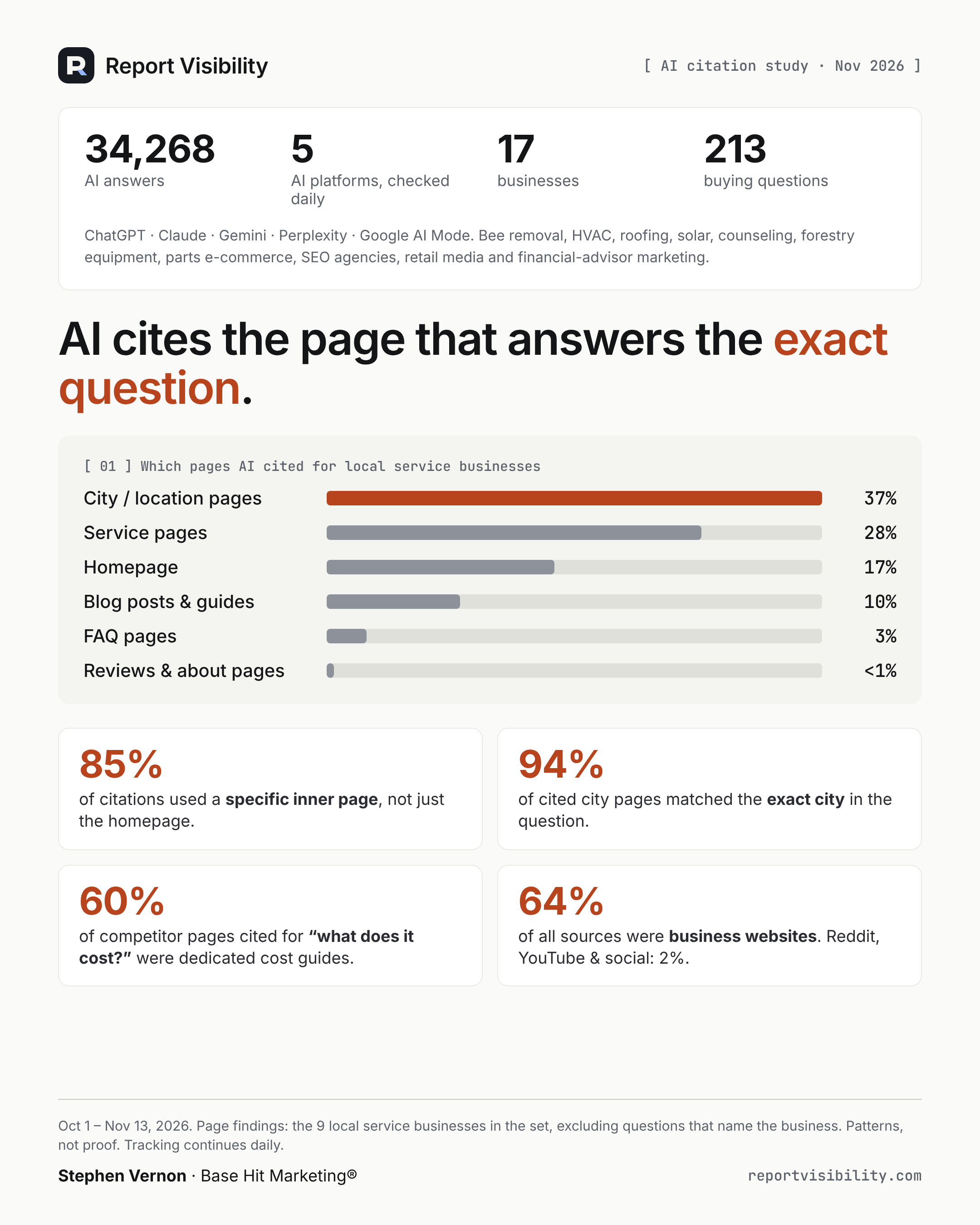
Since October 1, Report Visibility, the AI visibility tracker I run, has asked five AI platforms the same buying questions every day: ChatGPT, Claude, Gemini, Perplexity and Google AI Mode. Through November 13 that came to 34,268 answers for 17 businesses and 213 questions.
The businesses range from a bee removal company in Georgia and an HVAC contractor in Virginia to a forestry equipment manufacturer, an SEO agency and a retail media company. Nine of them are local service businesses. Those nine produced about 11,000 answers to questions that don't mention the business by name, and the page findings below come from them.
For every answer I logged whether the AI linked to the business's website and every source URL it cited. The source list is the part that matters here, because it shows which page on a site the AI picked.
Which pages get cited
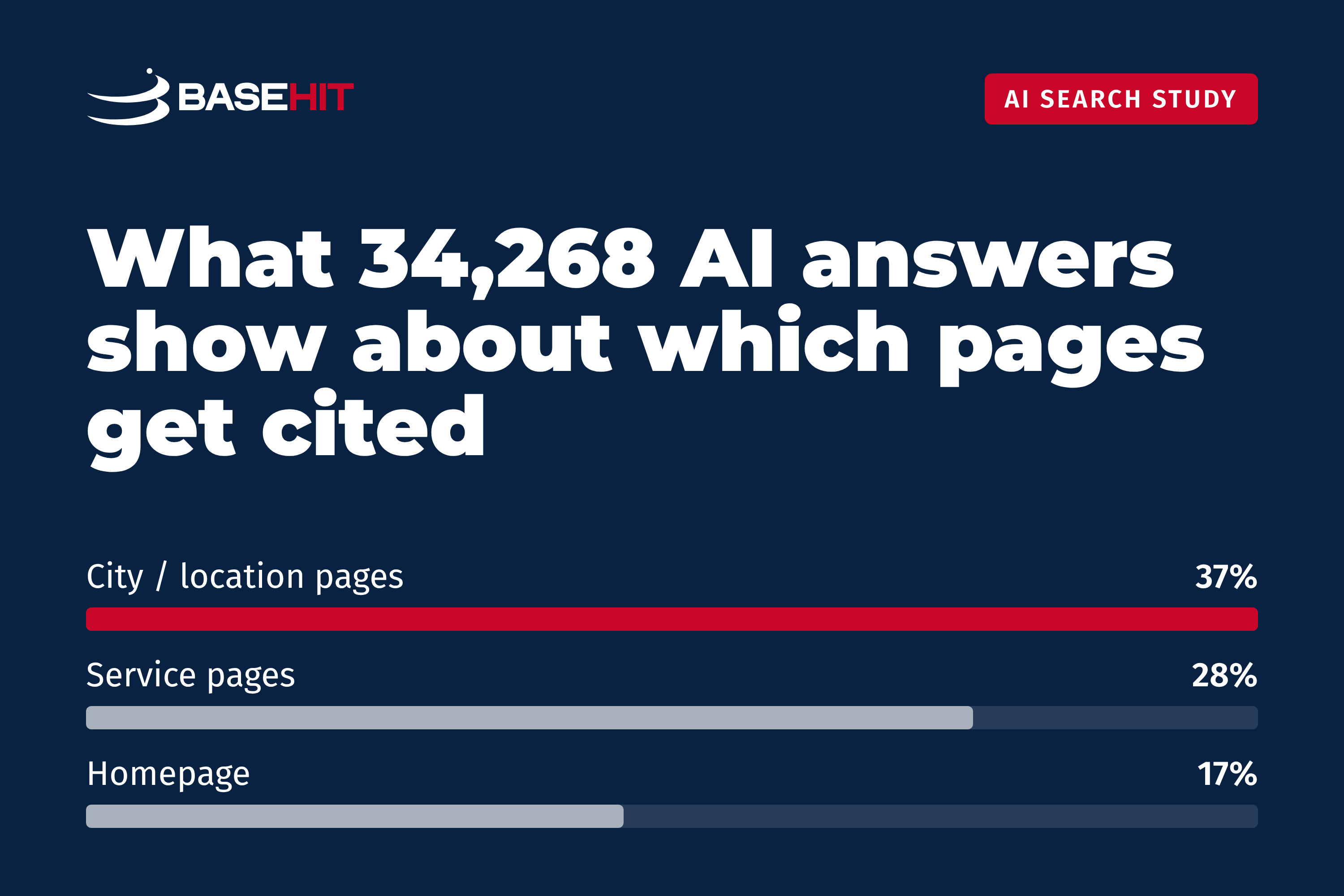
City pages drew 37% of citations for the local businesses, and the homepage drew 17%. Here's the full split of 3,735 citations to the businesses' own pages:
- City and location pages: 37%
- Service pages: 28%
- Homepage: 17%
- Blog posts and guides: 10%
- Careers pages: 4%
- FAQ pages: 3%
- Contact, reviews and about pages: about 1%
The careers slice comes mostly from one HVAC company, whose apprenticeship page answered a question about paid HVAC training in Virginia.
Specific pages win specific questions
85% of the citations to local businesses pointed at an inner page, not just the homepage. The AI matched the page to the question. Someone asking about EMDR therapy in Lynchburg was linked to a counseling practice's EMDR page. Someone looking for bee removal in Greenville, SC was linked to a bee removal company's Greenville page.
City pages were the clearest case. When the AI cited a city page, it matched the exact city named in the question 94% of the time. A page for some other town or for the whole region stood in only 6% of the time.
The question also has to carry a location. For local businesses, questions asking who provides a service were cited 33% of the time when they named a city or state, and about 1% of the time when they didn't. If you track prompts for a local business, write them the way a nearby customer would ask, with the town in them.
Cost questions go to whoever wrote the cost page
Questions like "what does a new roof cost in central Virginia?" rarely cited the businesses I track. Local businesses were cited in 8% of cost answers. The AI still needed sources, and 60% of the competitor pages it cited for these questions were dedicated cost guides.
Those guides follow a pattern. Most put the service and the location in the title and URL, and many add the year: "how much does a roof replacement cost in VA, 2026 guide" or "Tennessee roof replacement cost." Most of the businesses in this set don't have a page like that, so a competitor's page answers the question instead.
Where the AI gets its sources
Most sources were ordinary business websites. In answers for the local businesses, 64% of cited sources were companies' own sites, most of them competitors. Directories and review sites were 17% of sources, but at least one showed up in 53% of answers, usually BBB, Yelp, Angi, Thumbtack or a trade directory. Reddit, YouTube and other social sites were 2%.
The businesses' own reviews and about pages were almost never cited for buying questions (under 1% of citations). For reputation, the AI read BBB and the review sites. Those outside profiles are what it saw.
One check tells you very little
I paired each question with each platform and measured how often that pair cited the business over the tracking window. Of 305 pairs for the local businesses, 48% never cited the business and 11% cited it on at least 80% of days. The other 41% went back and forth.
An owner who asks ChatGPT once and sees their name, or doesn't, has learned very little. The rate over several weeks is the number to watch.
The platforms also differed a lot. For local businesses, Perplexity linked the business's site in 40% of answers and Google AI Mode in 14%. ChatGPT (21%) and Gemini (20%) were close together, with Claude a bit higher at 27%.
What I'd do with a local business site
Here's what I'd do, based on what got cited.
Build a page for each city you want to be recommended in, and make it about that city: the services you offer there, the neighborhoods you cover, your nearest office and a phone number.
Give each service its own page. The counseling practice in this set has separate pages for EMDR and psychological testing, and each one was cited for the question it matched.
Write the cost page. If customers ask what your service costs, a page with real price ranges for your area and the year on it is the kind of page AI cites. Without one, a competitor's page gets cited instead.
Track prompts the way customers ask them, with a location, and check all five platforms daily. Watch the rate, not a single answer. ChatGPT adds utm_source=chatgpt.com to about 60% of the links it gives, so you can also see that traffic in GA4.
How this was measured, and its limits
Report Visibility asks each tracked question on all five platforms once a day and stores the full answer and its sources. "Cited" means the answer linked to the business's own domain. Questions that name the business ("Is X a good company?") are left out of the rates above. The AI cites the business in about 82% of those, so they'd inflate every number.
Page types were assigned from each URL (city page, service page, blog post, FAQ, homepage and so on), and questions were tagged by their wording. The data covers October 1 to November 13, 2026.
These are patterns, not proof. I chose the questions, and nine local businesses is a small set. Nothing here shows that adding a page caused a citation. Six of the 17 businesses are national companies that were almost never cited, and two are equipment brands that sell nationwide, so the page findings come from the nine local businesses only. I'm still tracking daily and will update this as the data grows.