
What Happened to Google? Notes from the Country's Biggest Search Conference
By Stephen Vernon | BaseHit Marketing | June 2026
Based on presentations and transcripts from SMX Advanced 2026, Boston, June 4–5
I just got back from SMX Advanced in Boston. It's the most credentialed search marketing conference in the country — researchers, engineers, and strategists from Microsoft, Shopify, Semrush, Wix, and about two dozen independent firms.
The honest version of what I heard: the way customers find businesses online is changing faster than most business owners realize, and most of the advice still being passed around is already out of date.
The Numbers
80% of consumer buying journeys now include an AI touchpoint — meaning someone used ChatGPT, Gemini, Perplexity, or a similar tool at some point before making a decision. Two years ago that number was near zero. And 90% of those same journeys also included a traditional search — meaning AI isn't replacing Google, it's being inserted before it.
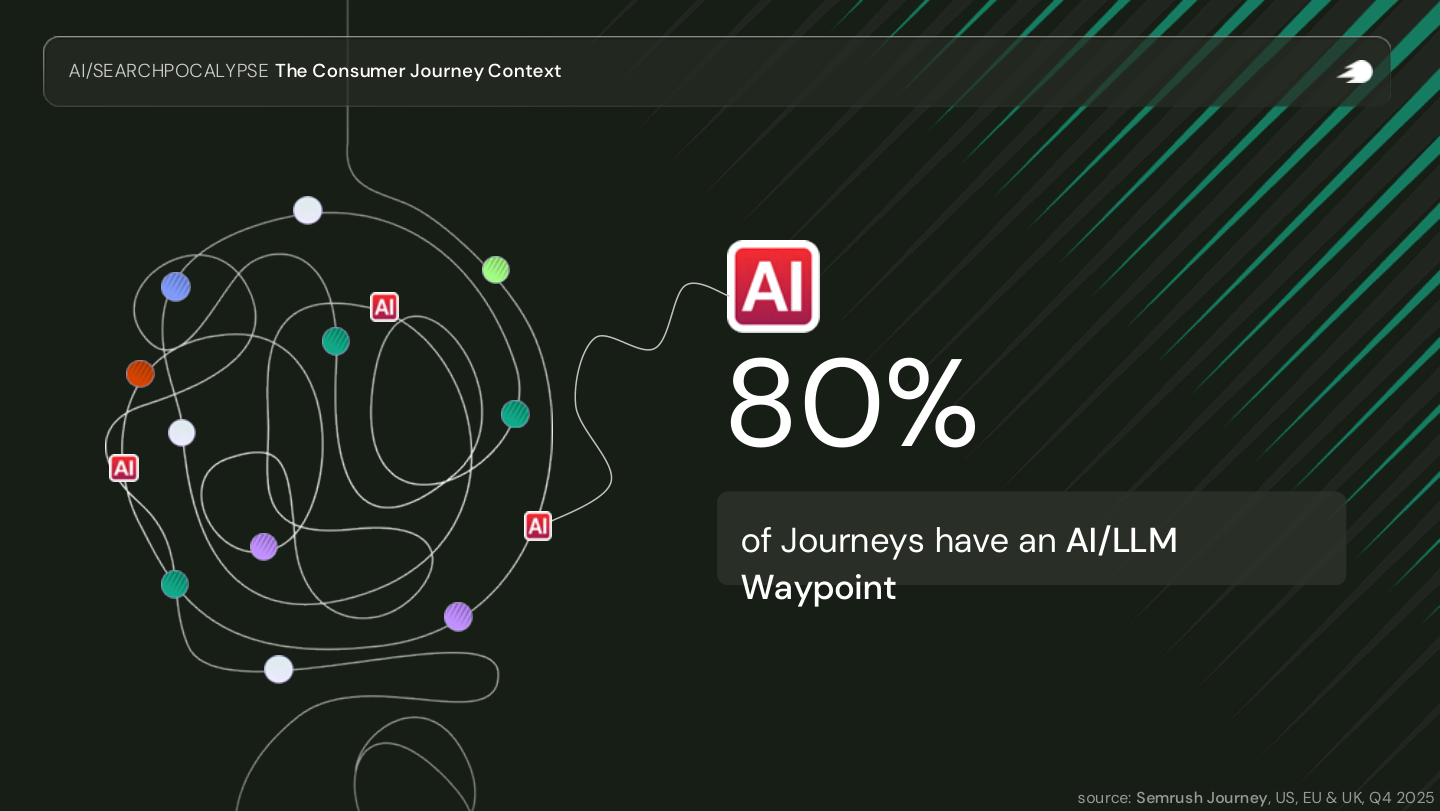
(Source: Semrush Journey clickstream database, US, EU & UK, Q4 2025 — cited in presentation at SMX Advanced 2026)
On a smartphone, the #1 organic Google result now sits below the visible screen on most searches. Ads, AI answers, shopping carousels, and local packs push it down before anyone scrolls. Research tracking 46,000 search terms found the median number-one organic result on a smartphone is below the fold. On informational queries, AI answers occupy the top several screens entirely.
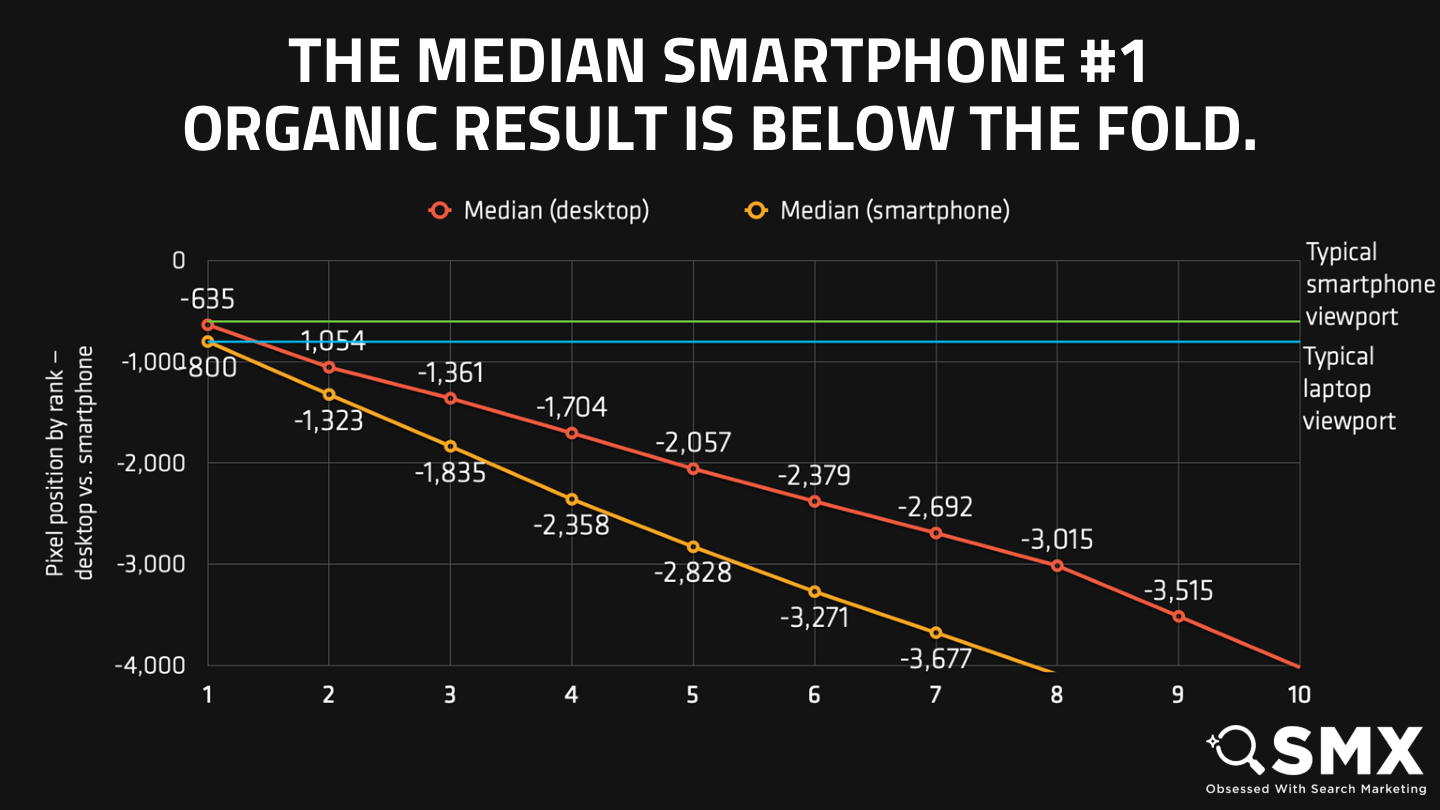
(Source: Pixel depth analysis across 46,000 search terms, May 2026 — presented at SMX Advanced 2026)
Those two data points together are the problem. Customers are using AI to decide who to call before they ever see your Google ranking.
How AI Actually Decides Who to Recommend
Traditional search ranked your website against keywords. AI works differently. When someone asks ChatGPT "who's the best HVAC company near me," the system pulls from dozens of sources simultaneously — your website, review platforms, news coverage, forum discussions, third-party directories — evaluates which sources seem most credible and consistent with each other, and synthesizes a single recommendation.
"LLMs are probabilistic systems trained on patterns of trust and repetition. If nobody talks about your brand, AI has very little reason to include it."— Previsible, SMX Advanced 2026
The practical implication: showing up is no longer just about your website. It depends on what the broader web says about you. If those outside sources are sparse, contradictory, or silent, the AI system has little reason to recommend you over a competitor with a stronger footprint.
What the Research Says Drives AI Recommendations
SOCi published their 2026 Local Visibility Index specifically on this question — what predicts whether a local business gets recommended by AI tools. Presented by Monica Ho, CMO of SOCi, at the conference.
Reviews are now a filter, not just a reputation signal
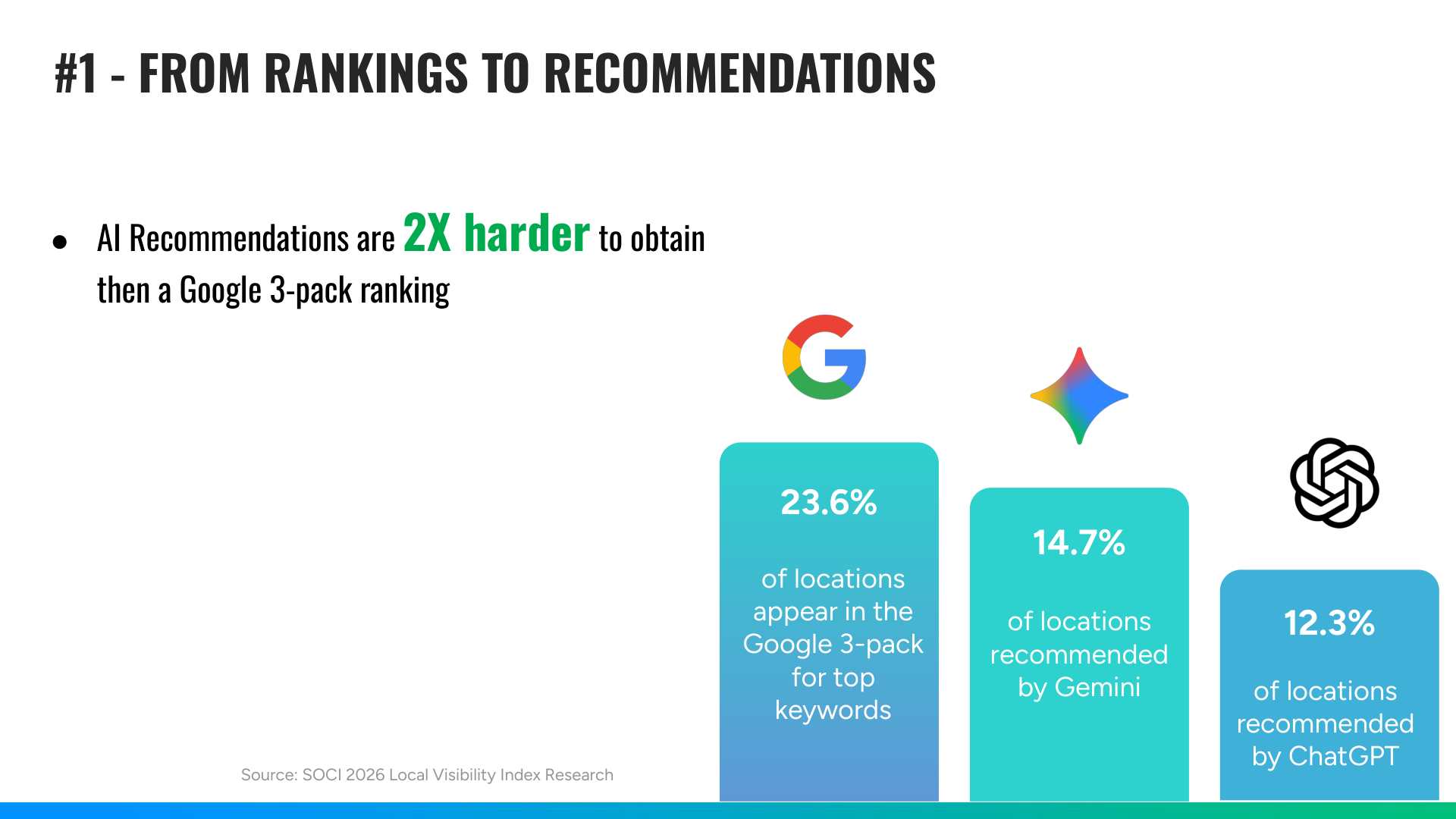
AI recommendations are 2x harder to obtain than a Google 3-pack ranking. Only 12–14% of local businesses get recommended by ChatGPT or Gemini for a given search, compared to 23.6% that appear in the Google 3-pack.
The average star rating of a business recommended by ChatGPT is 4.3 stars — compared to 4.2 for the average Google listing and 3.1 for the average Yelp listing. Businesses below 4.0 are largely screened out before a human ever sees the result. Not as a soft preference — as a threshold.

(Source: SOCi 2026 Local Visibility Index, presented by Monica Ho, CMO of SOCi, SMX Advanced 2026)
Brand mentions across the open web matter more than links
Research from Ahrefs found the strongest predictor of AI visibility is how often your brand is mentioned across credible third-party sources — YouTube videos, news articles, review platforms, local forums, and industry directories — outranking even backlinks. This was cited in Kyle Risley's presentation (Sr. SEO Lead, Shopify).
This is a meaningful shift: a mention in a local news story, a Chamber feature, or a regional podcast now has direct, measurable value for whether AI recommends you.
(Source: Ahrefs, "Top Brand Visibility Factors in ChatGPT," Dec 2025 — cited by Kyle Risley, Shopify, SMX Advanced 2026)
Your Google Business Profile is now an AI data source
GBP is no longer just a map listing. AI tools pull from it when assembling local answers. Incomplete profiles, unanswered reviews, weak photo libraries, and empty Q&A sections all reduce your inclusion odds. Listings with 100+ photos see significantly higher engagement.
(Source: Andrew Beckman, Location3; Andrew Shotland, Local SEO Guide — SMX Advanced 2026)
Data inaccuracy is a larger problem than most businesses know
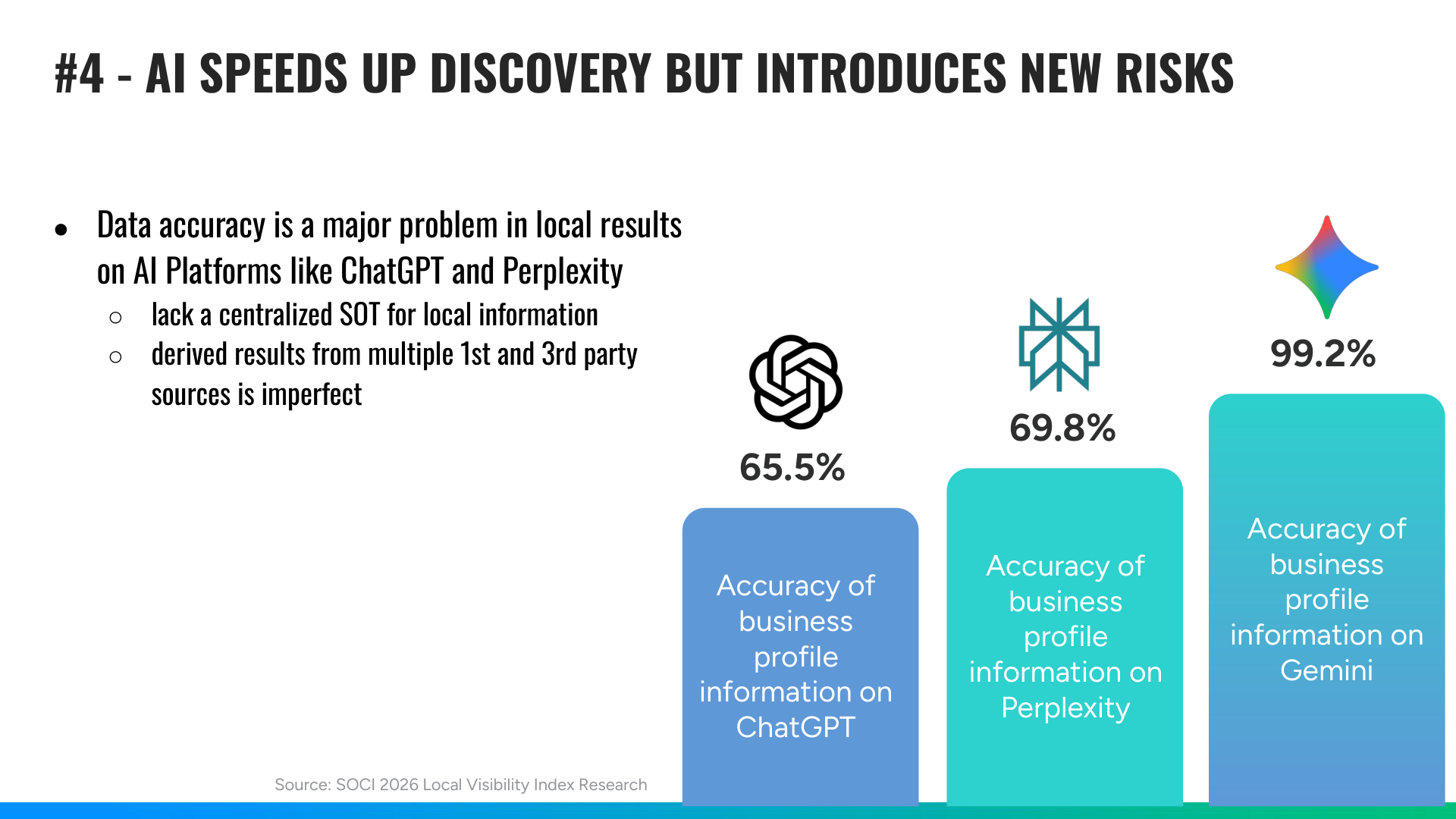
SOCi's research found only 65.5% of business information shown by ChatGPT is accurate. 69.8% on Perplexity. Gemini, which pulls directly from Google's own infrastructure, came in at 99.2%. Wrong hours, disconnected numbers, outdated services. If third-party directories have old data about your business, that wrong information can make it into an AI recommendation. Fixing it requires cleaning up the data around your business — not just your own website.
(Source: SOCi 2026 Local Visibility Index)
The Part That Should Make Executives Pay Attention
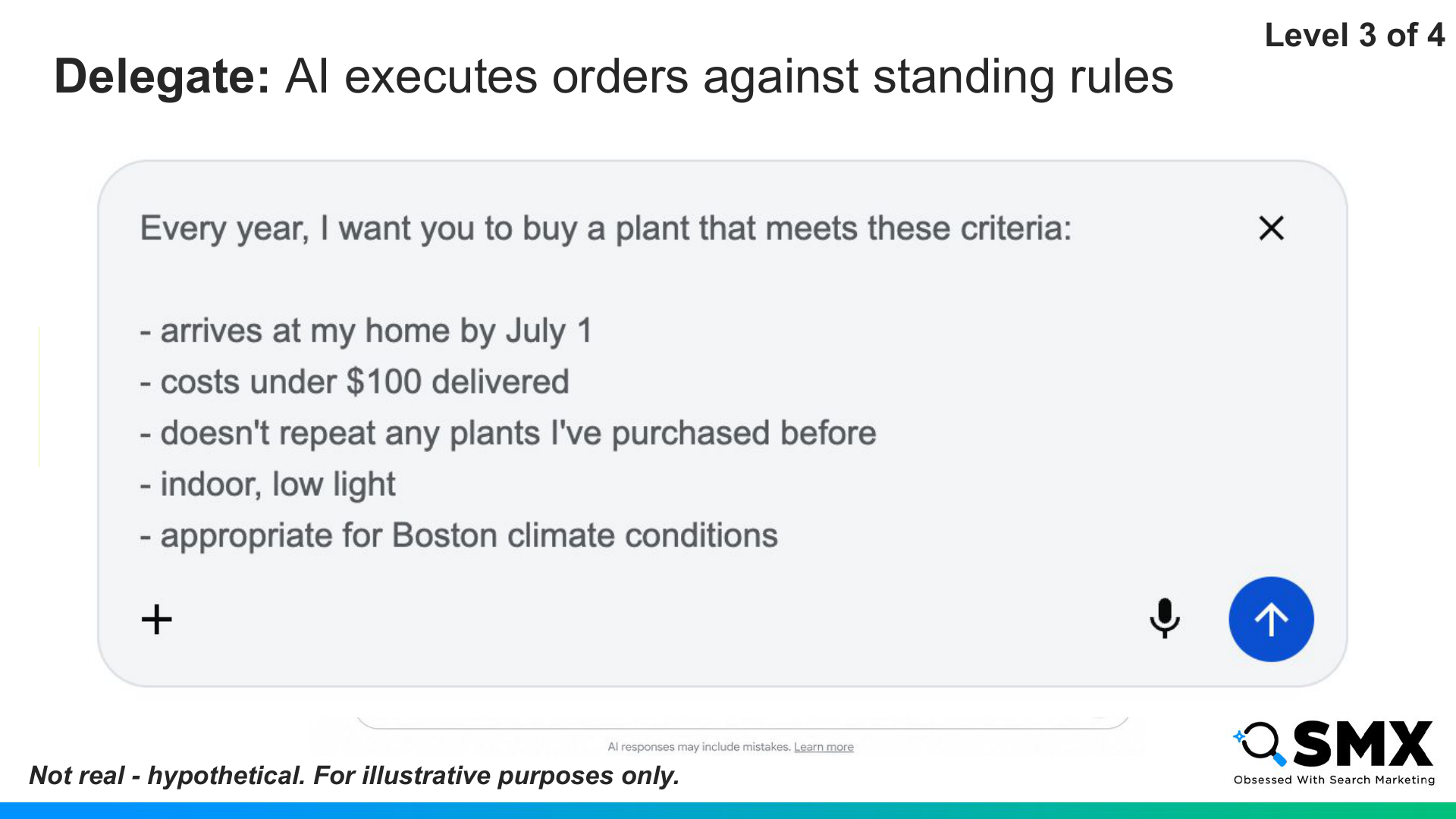
Kyle Risley, Sr. SEO Lead at Shopify, described what he called "agentic commerce." Right now: AI recommends. Next: AI books the appointment. After that: AI makes recurring purchases against standing rules the customer sets once, without doing anything again. Google has already launched early versions of this.
"Traffic is certainly not going to be the measure anymore. You are now serving data, and agents will consume it on behalf of the user."— SMX Advanced 2026 Closing Panel (transcript)
The closing panel included Mike King (founder, iPullRank), Martha van Berkel, and Duane Forrester. Forrester — a former Microsoft Bing insider — put the pace of change plainly:
In 1956, the average Fortune 500 company was 67 years old. By 2027, that average will be 21. The companies that built those fortunes are mostly gone. Consumer behavior drove that compression. AI is accelerating it.
"If you think this new version of search is the same as SEO, it will be a pleasure to meet all the new people taking your places."— Duane Forrester, SMX Advanced 2026 Closing Panel (transcript)
What to Do Starting This Month
Every presenter who offered practical guidance pointed to the same priorities.
Search your business name in ChatGPT and Perplexity. Read what comes back. Check whether your hours, address, phone, and services are accurate. If they aren't, trace the source and fix it there — not just on your own site.
Treat your Google Business Profile as a live product. Post weekly. Respond to every review. Seed the Q&A with real questions customers ask. Add geotagged photos consistently. Aim for 100+ photos and a 4.5+ star rating with a 100% response rate.
Build brand mentions outside your website. Local news, Chamber features, podcast appearances, relevant Reddit threads and Facebook Groups, Yelp, and industry directories. These are the sources AI tools weight most when deciding who to recommend.
Get above 4.3 stars. Not as a vanity metric. As the AI inclusion threshold backed by SOCi's research.
Ask your web developer whether your key content is visible without JavaScript. 69% of AI crawlers cannot execute JavaScript. If your services, location, or credentials only appear after JavaScript loads, AI search may not see them.
(Source: Vercel/MERJ 2024 research — cited by Sam Torres, Pipedrive, SMX Advanced 2026)
One More Thing
This isn't the first time I've come back from a conference with data that contradicts what most businesses are doing. Local U in Nashville covered similar ground on local search shifts earlier this year, and the trajectory has only accelerated.
If you want a free SEO audit that includes a check of how your business currently appears in AI tools, that's something I'm doing for businesses right now.
If you're an agency reading this and want to understand how to position this for your clients, the local SEO for agencies page has more context on how I work with white-label partners.
Stephen Vernon is the founder of BaseHit Marketing, an SEO consultancy based in Lynchburg, Virginia. basehitmarketing.com
Presentations from SMX Advanced 2026 referenced here were delivered by: Kyle Risley (Shopify), Monica Ho (SOCi), Sam Torres (Pipedrive), Andrew Beckman (Location3), Andrew Shotland (Local SEO Guide), Previsible, and the closing panel featuring Mike King (iPullRank), Martha van Berkel, and Duane Forrester. Pixel depth research presenter works for a rank tracking provider; presenter name was not identified in the deck.